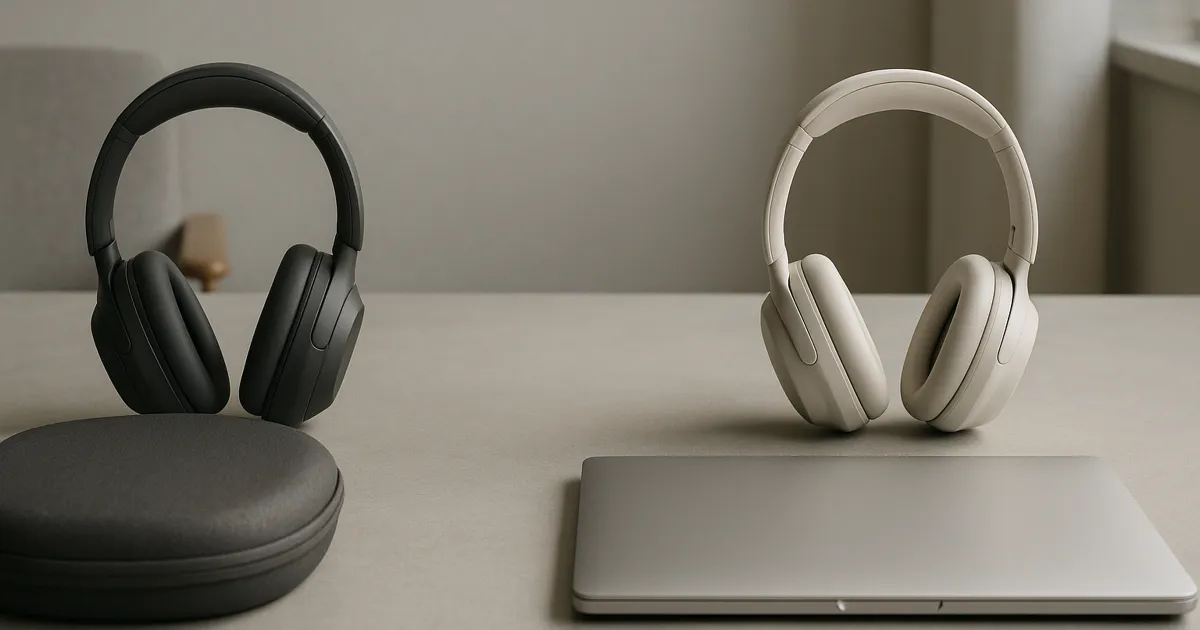
Sony WH-1000XM6 is the more flexible choice when you want ordinary two-device Bluetooth use plus an analog listening fallback that works with the headphones powered on or off. Bose QuietComfort Ultra Headphones (2nd Gen) is the stronger alternative when USB-C digital playback and its lighter documented weight fit your devices and priorities. Neither is a universal winner: call path, source device, app use, and individual fit can reverse the decision.
Fast decision map
- Choose Sony WH-1000XM6 for SBC, AAC, LDAC, and LC3 support, two-device multipoint, and powered or unpowered 3.5mm listening.
- Choose Bose QuietComfort Ultra 2nd Gen for documented USB-C digital audio, analog playback, and aptX Adaptive on a compatible Snapdragon Sound source.
- Choose neither as a guaranteed wired work headset. Sony’s analog path does not retain the headphone microphone, and the cited Bose testing disables the microphone on wired paths.
- Keep the return window open. Head shape, glasses, hair, clamp, pad seal, firmware, and the calling application can matter more than a specification-table win.
If you are still comparing other over-ear models, start with our broader noise-canceling headphones for calls and travel guide. This page answers only the narrower Sony-versus-Bose decision.
Identity and connection paths
The exact model names matter. This comparison covers Sony WH-1000XM6 and Bose QuietComfort Ultra Headphones (2nd Gen), not the earlier Sony XM5 or first-generation Bose Ultra. Accessories, firmware notes, test records, and retailer listings can differ between generations.
Sony documents Bluetooth 5.3 with SBC, AAC, LDAC, and LC3. Its help guide lists a 3.5mm path at different impedance values depending on whether the headphones are powered on or off. Sony also documents multipoint and app-based settings. The practical advantage is a simple analog listening fallback for an aircraft seat, older laptop, or another source with a headphone jack. That fallback is listening-only from the headphone’s perspective: it should not be purchased as proof of a wired microphone path.
Bose documents Bluetooth 5.4, an included analog cable, and USB-C digital audio at 16-bit/44.1 or 48 kHz from compatible sources. Its USB-C path is useful when a laptop, phone, or tablet supports class-compatible digital output. Bose also describes a lower-latency gaming mode for compatible Snapdragon Sound sources using aptX Adaptive. Both endpoints must support the feature; a codec or mode printed on the headphone page does not add it to an incompatible laptop.
Both models support a two-device workflow, but test the exact handoff you need. Start music on the laptop, answer a call on the phone, end it, and return to the laptop. Then repeat inside the meeting application. Our multipoint laptop-and-phone guide explains why pairing memory and two active devices are different claims.
Noise control and listening features
Manufacturer language and independent testing answer different questions. Sony describes an adaptive system built around its QN3 processor and twelve microphones. Bose describes adjustable noise cancellation, Quiet and Aware modes, and ActiveSense. Those are first-party feature descriptions, not a common comparative measurement.
The exact-model RTINGS records cited in our broader guide use the same v2.3 method. Under that method, both models showed strong overall isolation, with Bose measuring slightly longer continuous battery life: 37 hours versus 31.75 hours for Sony. Those figures are useful because the method is shared. They are not promises for every codec, volume, call mix, feature setting, firmware version, or battery age.
Do not treat active noise cancellation as hearing protection or a safety system. It changes the listening experience but does not establish a certified attenuation rating, a safe listening level, or suitability around traffic and machinery. Use purpose-rated protection where the environment requires it.
Calls and controls
Sony combines a touch surface with tactile controls for functions including power, noise-control mode, and a configurable microphone mute. Sony notes that the headset mute does not necessarily mute the source device’s microphone indicator, so confirm status inside the call application. Bose uses a Bluetooth/power button, a multifunction button, and a capacitive volume strip with a configurable shortcut.
For wireless calls, neither product can guarantee the same result across Teams, Zoom, FaceTime, carrier calls, Windows, macOS, Android, and iOS. The host chooses Bluetooth profiles and may add its own processing. Record a short sample in the actual application, then test with representative background sound.
For wired calls, stop at the documented boundary. Sony’s analog cable leaves call capture to the source device rather than the headphone microphone. The cited Bose exact-model testing reports the microphone disabled over the tested wired paths. A USB-C playback label therefore does not make either model a dependable wired communications headset. If a stable desk-call chain is the priority, our USB versus XLR microphone guide separates capture hardware from headphone playback.
Comfort, fit, and a useful return-window test
Bose lists the headphone at 0.583 lb, while Sony lists approximately 254 g. The difference is small enough that headband shape, clamp, pad contact, and heat can matter more than the scale. A lab reviewer’s comfort note cannot predict pressure points on another head.
Use the same repeatable check for either model:
- Wear it for the longest normal session, not only a five-minute setup.
- Repeat the test with glasses, hair, or a hat arranged as they would be during travel.
- Check whether the pad seal changes when you turn or speak.
- Test music, a call, and the intended wired fallback on every primary host.
- Put the headphones in the case and confirm the case fits the bag you actually carry.
- Keep the packaging until the workflow and fit tests pass.
This is a compatibility and ownership check, not a health assessment. Discomfort is a reason to stop the session and use the return path, not evidence that one design is inherently suitable for everyone.
App dependence and ownership
Sony Sound Connect owns configuration and firmware for several XM6 features. Bose says basic Bluetooth listening can work without its app, while complete personalization, settings changes, and updates use the Bose app. Decide which features matter before granting permissions or creating an account, and retain a note of the firmware version when testing.
App dependence is not automatically disqualifying. It is an ownership tradeoff: a companion app can expose useful controls and updates, while also adding another compatibility and support dependency. Verify that the basic listening and control path remains acceptable if the app is unavailable on a future device.
Which model should you choose?
Choose Sony WH-1000XM6 when ordinary cross-platform multipoint, the broader documented codec list, and a powered-or-unpowered analog listening backup form the most useful combination. It is our balanced choice for travelers who expect Bluetooth calls but still want a simple listening cable.
Check the current Sony WH-1000XM6 price on Amazon.
Choose Bose QuietComfort Ultra Headphones (2nd Gen) when USB-C digital listening and its lighter manufacturer-listed weight matter more, and when your source devices support the connection features you plan to use. Treat aptX Adaptive as a compatible-host feature, not a universal benefit.
Check the current Bose QuietComfort Ultra 2nd Gen price on Amazon.
Skip both if the non-negotiable requirement is a wired microphone, a certified hearing-protection rating, or freedom from all companion-software dependencies. A separate call headset or microphone can create a clearer work path than asking one travel headphone to do every job.
Method and evidence boundary
This comparison uses current exact-model Sony and Bose documentation for identity, connections, controls, app requirements, and manufacturer specifications. The shared RTINGS v2.3 records are used only for bounded exact-model battery, isolation, microphone, and comfort observations already documented in our category guide. We did not personally test either product, state a price, use customer ratings or review counts, or infer long-term reliability.
Sources
- Sony WH-1000XM6 announcement and specifications: https://www.sony.com.hk/press/pdf/20250516_e.pdf and https://helpguide.sony.net/mdr/2984/v1/en/contents/TP1001863304.html
- Bose QuietComfort Ultra Headphones (2nd Gen) product page and owner documentation: https://www.bose.com/p/headphones/bose-quietcomfort-ultra-headphones-2nd-gen/QCUH2-HEADPHONEARN.html
- Exact-model independent records: https://www.rtings.com/headphones/tools/compare/bose-quietcomfort-ultra-headphones-2nd-gen-vs-sony-wh-1000xm6/112689/63313